
The Best Puzzle Tables, Puzzle Boards & Puzzle Mats
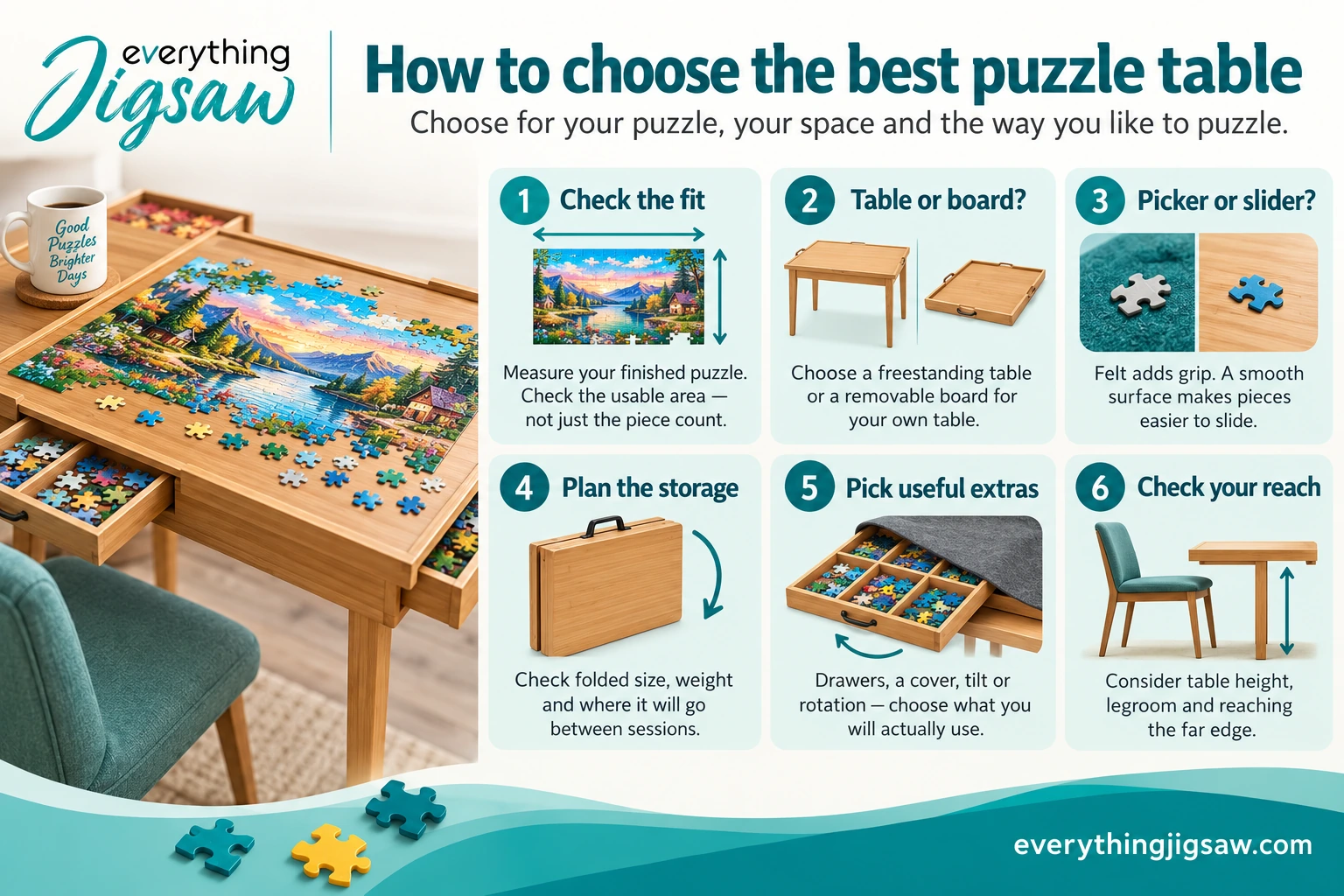
How to choose the best puzzle table for you. Do you need to rotate your puzzle, store pieces in drawers, fold or tilt the table, or collapse it to make more room? Puzzle tables and boards can be wooden or portable, with options for 500, 1000, 1500 or even 2000-piece puzzles. Check your puzzle’s finished size against the usable area of the one you choose.
I’m Geoff, a former Director of Product Development with over 20 years of puzzle experience at Gibsons Games, including developing their top-rated Puzzle Board. See my recommended puzzle tables, boards and mats below. Or, if you really want to, make your own from an IKEA kitchen door!
Affiliate disclosure: Thank you so much for visiting! Some links on this page are affiliate links. If you buy through them, I may earn a commission. As an Amazon Associate I earn from qualifying purchases. If you choose to buy through my links, a genuine big thank you!
Table, board or mat?
I need my dining table back. What should I use?
A freestanding table gives you another workspace. A removable board uses the table you already have, then lets you move the unfinished puzzle. If there is nowhere to keep a second table, I would start with the board.
Can I put a puzzle table under my bed?
Possibly, but measure the clear space under the bed as well as the board or folded table. The Bits and Pieces Fold-and-Go folds to 37¾ × 26½ × 2½ inches and weighs 24 lb. Allow for bed legs or drawers and the space to slide it in; if lifting 24 lb would be awkward, consider a removable board instead.
Will my 1000-piece puzzle fit?
The piece count alone will not tell you. White Mountain’s New York New York measures 30 × 24 inches: it leaves only 1 inch in the tighter direction on the Fold-and-Go and 0.8 inch on the Becko PTZ005. See the published-size fit table for more examples, then use the size on your own puzzle box.
Would a roll-up mat be easier to store?
A puzzle mat rolls away and still needs a flat surface while you puzzle. Pieces can shift as you roll it. If you already have a table and want a rigid surface, a simple foam board is another option, though it has no raised edges.
How I chose these: When developing the Puzzle Board with Gibsons, certain features became more important in real life than a brief look online.
Two freestanding tables to compare
Choose the Bits and Pieces Fold-and-Go if folding the table away matters most. Choose the Becko PTZ005 if you want height adjustment, tilt and wheels. Check your puzzle, chair and storage space whichever you choose. Boards and mats could be alternatives for easier storage.
Bits and Pieces Fold-and-Go
- Choose it for
- A table with folding legs and side sorting panels.
- Usable area
- 34 × 25 inches.
- Storage
- Folded: 37¾ × 26½ × 2½ inches; listed weight: 24 lb.
- Main tradeoff
- Bear in mind the weight to lift and store.
- Model
- Manufacturer SKU 48130.
Becko US PTZ005
- Choose it for
- Adjustable height, tilt and four casters.
- Usable area
- 35.04 × 24.8 inches.
- Storage
- Lower shelf and cover mat; folded dimensions not confirmed.
- Main tradeoff
- Requires assembly; check its overall size with the seller.
- Model
- PTZ005, Amazon ASIN B0936DSFBS.
Fold-and-Go: for a workspace you can fold away
The folding legs and felt-covered side panels make this a good choice when a permanent puzzle table would get in the way. Its 34 × 25-inch assembly area is distinct from its folded size: allow room for the whole table when storing it, and for the panels when open.
The drawback is its listed 24 lb weight. If it is too heavy to lift or too awkward, consider a puzzle board or a puzzle table with wheels instead. Check your chair against the manufacturer’s approximately 30-inch table height. Do not shorten the legs to create a tilt.
View Fold-and-Go at Bits and Pieces
Becko PTZ005: for adjustable height and tilt
This freestanding table combines a lower shelf, cover mat and four casters. The brand lists five tilt settings, up to 30 degrees, and height adjustment from 29.5 to 37.4 inches. Its published usable area is 35.04 × 24.8 inches.
Choose it when those adjustments matter more than folding storage. It requires assembly, and the listing gives conflicting overall dimensions, so confirm the footprint before planning a tight space. If you need a table that folds away, the Fold-and-Go is the better choice. Tilt and height adjustment are useful features and not a guarantee to prevent pain. Always keep moving - especially important when you are engrossed in your puzzle and time flies!
What Size of Jigsaw Puzzle Board do I need?
You need the right-sized board for your puzzle. How much room you have to sort pieces depends on your puzzle’s actual finished dimensions and the board’s usable area inside any raised edges. Check both before buying.
The table gives reference sizes from puzzle examples by seven brands, checked against manufacturer pages on September 23, 2026. Please check the size of your own puzzle on the box. Puzzle companies can change sizes, and some puzzles are panoramic (especially Eurographics) or even square!
Cobble Hill’s 500-piece and White Mountain’s 1000-piece examples here need a larger puzzle table or board than many others such as Ravensburger at the same piece count. This is probably the most important thing to remember when choosing a table, board or mat.
If in doubt, I would go for a larger working area. A board sold for 1500-piece puzzles may give a 1000-piece puzzle more sorting room. The larger area can give you flexibility for different-sized 1000-piece puzzles and extra room at the sides, but make sure you have room for it and can lift and store it easily.
These are examples, not sizes for every puzzle from a brand. Centimetre and inch values are rounded where needed; check the dimensions printed on your box. I know during my time at Gibsons that puzzle sizes do change!
| Brand | 500 pieces | 1000 pieces | 1500 pieces | 2000 pieces |
|---|---|---|---|---|
| Ravensburger | 49 × 36 cm (19.3 × 14.2 in) | 70 × 50 cm (27.6 × 19.7 in) | 80 × 60 cm (31.5 × 23.6 in) | 98 × 75 cm (38.6 × 29.5 in) |
| Buffalo Games | 54 × 38 cm (21.25 × 15 in) | 68 × 50 cm (26.75 × 19.75 in) | 80 × 60 cm (31.5 × 23.5 in) | 98 × 67 cm (38.5 × 26.5 in) |
| Cobble Hill | 68 × 49 cm (26.625 × 19.25 in) | 68 × 49 cm (26.625 × 19.25 in) | Not confirmed | 100 × 68 cm (39.25 × 26.625 in) |
| Pomegranate | 61 × 46 cm (24 × 18 in) | 74 × 51 cm (29 × 20 in) | 99 × 51 cm (39 × 20 in) | 94 × 69 cm (37 × 27 in) |
| White Mountain | 61 × 46 cm (24 × 18 in) | 76 × 61 cm (30 × 24 in) | Not confirmed | Not confirmed |
| Eurographics | 67 × 49 cm (26.5 × 19.25 in) | 67 × 49 cm (26.5 × 19.25 in) | Not confirmed | 96.8 × 67.6 cm (38.11 × 26.61 in) |
| Gibsons | 48 × 34 cm (19 × 13 in) | 68 × 49 cm (27 × 19 in) | Not confirmed | 98 × 68 cm (39 × 27 in) |
Buy a larger board if you want to sort on the same surface, otherwise buy a puzzle tray sorter.
Example: a 30 × 24-inch puzzle
It fits within the published usable areas of both shortlisted tables. On the Fold-and-Go, that leaves 4 inches along one dimension and 1 inch along the other in total, not on every edge.
Example: a 36 × 25-inch puzzle
It does not fit either shortlisted usable area, even when turned. Choose a larger documented working area; a “1500-piece” label does not settle the question.
These are size examples, not specifications for a particular puzzle brand whole range. Before buying, note the product’s overall size, storage size and the clearance needed for drawers, legs or rotation.
Will my puzzle fit? Published-size examples
Here are ten real puzzles, not a size promise for every puzzle with the same piece count. The Fold-and-Go has a published 34 × 25-inch assembly area; Becko gives 35.04 × 24.8 inches of usable area. I checked both ways round. These labels are calculations from published sizes, not physical tests. Scroll the table sideways on a small screen to see both results.
| Puzzle example | Finished size | Fold-and-Go | Becko PTZ005 |
|---|---|---|---|
| Gibsons: Streets of London (500) | 48 × 34 cm | FITS COMFORTABLY | FITS COMFORTABLY |
| Ravensburger: Evening in Paris (500) | 49 × 36 cm | FITS COMFORTABLY | FITS COMFORTABLY |
| Pomegranate: Dracula in Dr. Seward's Library (500) | 24 × 18 in | FITS COMFORTABLY | FITS COMFORTABLY |
| Cobble Hill: Sugar Skull Cookies (1000) | 26.625 × 19.25 in | FITS COMFORTABLY | FITS COMFORTABLY |
| Eurographics: The Last Supper (1000) | 26.5 or 26.6 × 19.25 in | CANNOT DETERMINE | CANNOT DETERMINE |
| Pomegranate: Mystery of the Missing Migrants (1000) | 29 × 20 in | FITS COMFORTABLY | FITS COMFORTABLY |
| White Mountain: New York New York (1000) | 30 × 24 in | FITS — LIMITED SPARE ROOM | FITS VERY TIGHTLY |
| Buffalo Games: Places You Will Go (1500) | 31.5 × 23.5 in | FITS — LIMITED SPARE ROOM | FITS — LIMITED SPARE ROOM |
| Ravensburger: Whole Universe (1500) | 80 × 60 cm | FITS — LIMITED SPARE ROOM | FITS — LIMITED SPARE ROOM |
| Pomegranate: Wild World (1500) | 39 × 20 in | DOES NOT FIT | DOES NOT FIT |
How to read the labels: FITS COMFORTABLY means at least 4 inches left over in both directions; FITS — LIMITED SPARE ROOM means 1 to under 4 inches along the tighter direction; FITS VERY TIGHTLY means 0 to under 1 inch; DOES NOT FIT means it exceeds the working area both ways round. CANNOT DETERMINE means a needed size is missing or conflicts. Spare room is the total across a dimension, not the space at every edge or guaranteed sorting room. I used the unrounded centimetre conversion where supplied.
Eurographics gives two different lengths for The Last Supper on the same product page, so I have held that example. The exact ALL4JIG board on this page has no confirmed usable area, so I cannot add it to this comparison. For the tight fits, check the box and working-area measurement yourself before ordering.
What problem do you need to solve?
A dedicated table can leave your main table free. A removable board can let you put an unfinished puzzle away - possibly under your bed for example. Drawers give you separate sorting spaces, while a cover can help stop pieces going astray (or being eaten by your cat!). Decide which of these actually matters in your room before paying for extra features.
Plan the moving of the table as well as its storage: check weight, handles, doorways and how pieces are held. A cover or drawer is not a guarantee against pets, spills or pieces shifting but they help.
Owners’ Corner: what is it actually like to use?
When I helped develop the Gibsons Puzzle Board, I learned that the small practical details matter once you live with a board. I have not used every product in this guide. These are questions I would ask before choosing one.
- Moving and storage: Can you lift it with a puzzle in progress? Measure its stored size, the route to its storage place and the room needed to open it.
- Drawers and covers: Check how far drawers pull out and whether a cover holds loose pieces in place when you move the board. A cover is not a promise against cats or spills.
- Surface, rotation and reach: If you slide pieces, felt may feel different from a smooth board. Leave room to turn a rotating board and reach its far edge.
- Real puzzle fit: Measure the finished puzzle, not just its piece count. The table above leaves out sorting trays and any space you need for your hands.
What owners have said elsewhere
These are individual experiences, not my hands-on tests or an overall rating. The links go to the original discussions, separately from the buying links above.
- Bits and Pieces Fold-and-Go: One owner describes storing it under a couch but finding it hard to fold and unfold alone. Read the external discussion.
- Becko’s wheeled, height-adjustable 1500-piece table: A Reddit owner names the table and describes using it. Read the Reddit discussion. The exact retailer variant is not stated, so check the listing details before relying on that experience.
Puzzle Surface – Are you a Picker or Slider? Felt or Wood?
How do you like to puzzle?
Are you a ‘Picker’ who picks up and places each piece? Or are you a ‘Slider’ who slides the piece to its new home?
A ‘Picker’ may prefer a ‘carpet’ type of surface, such as felt, with some depth so you can get your fingers or fingernails under a piece. A ‘Slider’ may prefer a smooth surface and find felt too rough and slow. It is a personal preference, so check the finish of the exact model you are considering.
| Pros | Cons | |
|---|---|---|
| Felt | Provides a non slip surface that helps to hold puzzle pieces in place. | Can be difficult to slide pieces around - especially for wooden puzzles. |
| Soft texture can prevent damage to puzzle pieces. | Very prone to lint & puzzle dust. | |
| Wood or MDF | Smooth surface allows for easy movement of puzzle pieces. | Pieces might slip & slide around too easily, especially if the table is angled. |
| Doesn't crease & is more durable | Can be heavy and less portable than other materials. | |
| No lint or dust - can be easily wiped. | Can be a 'hard' surface to lay your palms on for a prolonged time. | |
Boards: clear the table without buying another table
A board sits on a surface you already own. Check that surface can support the entire board and leave room to open drawers. Measure the intended storage space with handles and the turning circle if it also rotates!
ALL4JIG rotating board with six drawers
The 1500-piece, six-drawer model has a rotating base and cover. It could be a good option if you need to rotate the puzzle, if you find it harder to reach, for example.
View ALL4JIG six-drawer board on Amazon
Portfolio storage: PortaPuzzle
A portfolio-style board is worth considering if you want to close a puzzle inside a case. Jumbo’s PortaPuzzle Standard is a classic portfolio-style puzzle board. Its published dimensions can differ across manufacturer and US retailer listings, so worthwhile double checking both the usable area and closed size before you buy.
Boards with a stand
A tabletop stand offers a different setup from a freestanding table. Check the supported board size, how it stays in place and the space occupied by the stand.
Drawers and covers: check the exact version
Drawers can separate sorted pieces from your working area. Check how far they pull out and whether they stay closed during the move you intend to make. Do not assume a drawer board also tilts.
If a Becko, MasterPieces or PuzzleReady drawer board catches your eye, check the exact model and usable area. A familiar product name or photograph does not establish which size or version you are buying.
Mats: when roll-up storage is the priority
A roll-up mat can be great for carrying - much easier than a rigid board. Do read the instructions very carefully though for the exact mat, tube and straps. I found out to my cost that some straps and rolls are better than others - when the pieces fell out!
Measure the documented puzzle area, not just the fabric. A tube, borders or rolling margins can make those different. If keeping your pieces safe and flat matters more than the storage and portability, consider a board instead.
Jumbo Puzzle & Roll
Jumbo’s Puzzle & Roll model 17691 is the original puzzle roll mat. Check its puzzle area and storage instructions. View Jumbo’s model information.
Other roll-up systems
For alternatives from MasterPieces or PuzzleReady, compare the exact mat’s working area and included storage pieces before choosing.
A simple foam board
Before buying a dedicated puzzle board, consider whether a plain rigid board on your existing table would solve the problem. A foam board is one option that has been used successfully but it does have two major limitations. The surface is very smooth (so not so easy to pick up a piece), and foam boards are brittle and can easily snap. If joining two sheets together to make a larger board, take extra care - or just don't do this!
A third (minor) disadvantage is the lack of raised edges to help keep the pieces on the board.
IKEA and other DIY ideas
IKEA’s puzzle-storage idea uses a panel and casters for under-bed storage. It is an Australian example, so check what components you can buy locally.
For a homemade board, plan the usable area before adding edging or a surface covering. Adding edges will reduce the usable space.
Keeping a finished puzzle
Puzzle glue is an option if you want to keep your puzzle assembled. Very popular in Japan and they are framed as well! Check the glue’s instructions and suitability for your puzzle’s material and finish. Protect the working surface and allow the stated drying time before moving it.
Adhesive sheets
Puzzle backing sheets are another option although I haven't used these before. Check their instructions, coverage and suitability before turning or lifting a finished puzzle!
Choose around your room and your puzzle
Start with the finished puzzle’s size. Then decide what usable size you need and then whether you need a table, a removable board or roll-up storage. Folding storage favours the Fold-and-Go; adjustable height and tilt favour the Becko PTZ005. If neither suit, consider boards with extra features such as rotation, or a puzzle board or mat.
How this guide was researched
The seven-brand puzzle size examples were checked against manufacturer pages on September 23, 2026. Sizes can changeso check again before you buy
The Bits and Pieces product page and Becko’s Amazon listing supply the main comparison specifications. The ALL4JIG product family, Jumbo PortaPuzzle model page and PuzzleReady board family provide more details on the other options.

